
Микробиологическое снижение содержания афлатоксина М1 в молочных продуктах: систематический обзор эффективности, механистических ограничений и аналитической достоверности
Микробиологическое снижение содержания афлатоксина М1 в молочных продуктах: систематический обзор эффективности, механистических ограничений и аналитической достоверности

Аннотация
Афлатоксин M1 (AFM1) относится к канцерогенам 1-й группы и обнаруживается в молоке лактирующих животных, получавших корм, загрязнённый афлатоксином B1. Традиционные методы обеззараживания часто неэффективны или носят обратимый характер.
Цель исследования: систематический обзор и критическая оценка эффективности, механизмов действия (адсорбция vs. деградация) и аналитического качества микробиологических методов детоксикации AFM1 в молочной продукции, а также выявление барьеров для промышленного и регуляторного внедрения.
В соответствии с рекомендациями PRISMA 2020 проведён систематический поиск в шести базах данных (PubMed, Scopus, Web of Science, Google Scholar, Semantic Scholar, OpenAlex) по оригинальным исследованиям, опубликованным с января 2015 по январь 2026 года. Для оценки качества исследований использовался модифицированный инструмент оценки риска систематической ошибки (Risk of Bias, RoB), адаптированный из руководств SYRCLE и ARRIVE. Оценивались: аналитическая валидация (указание предела обнаружения, предела количественного определения и процента извлечения), механистическая ясность (тестирование десорбции или деградации), матричная специфичность и прозрачность процедур.
В анализ включено 34 оригинальных исследования. Основными агентами детоксикации были молочнокислые бактерии (33 из 34), далее следуют дрожжи (9 из 34). В 12 исследованиях сообщалось об эффективности удаления AFM1 >90%, однако в 30 из 34 работ снижение уровня токсина было связано с обратимой адсорбцией на клеточной стенке, а не с ферментативной деградацией. Лишь четыре исследования продемонстрировали истинную деградацию. Более 65% публикаций не содержали критически важных параметров валидации (предел обнаружения, предел количественного определения или процент извлечения).
Современные исследования микробиологической детоксикации AFM1 ограничены «механистической неопределённостью» (преобладание обратимой адсорбции) и «аналитическим пробелом» (отсутствие строгой валидации). Эти проблемы препятствуют регистрации методов и их промышленному масштабированию. Будущие исследования должны делать приоритет на необратимой биотрансформации (например, с использованием ферментов или биоактивных соединений, таких как куркумин) вместо временной секвестрации для обеспечения безопасного, без остаточных токсинов молочного производства.
1. Introduction
Aflatoxin M1 (AFM1) is the primary hydroxylated metabolite of aflatoxin B1 (AFB1), secreted into the milk of lactating mammals within 12–24 hours of dietary AFB1 exposure
, . Retaining the hepatocarcinogenic, mutagenic, and immunosuppressive properties of its precursor, AFM1 has been classified as a Group 1 human carcinogen by the International Agency for Research on Cancer (IARC) . The European Union (EU) regulatory maximum residue limit (MRL) for AFM1 in liquid milk is 50 ng/L, yet surveillance data from African and Asian markets consistently document mean concentrations exceeding this threshold, with episodic peaks above 500 ng/L , , . In processed dairy derivatives, the hazard is compounded: a global meta-analysis of cheese products revealed mean AFM1 concentrations as high as 13,000 ng/kg in cow-derived varieties .The thermal stability of AFM1 under conventional pasteurization and ultra-high temperature (UHT) processing underscores the inadequacy of standard milk safety protocols and has stimulated a diverse body of research into post-contamination mitigation strategies
. Among these, biological interventions employing living or non-viable microorganisms have attracted particular attention due to their GRAS (generally recognized as safe) status and compatibility with fermented dairy production , . However, two structural deficiencies pervade the existing literature and impede regulatory adoption.The first is a Mechanism Ambiguity Bias: the overwhelming majority of reported biological decontamination relies on reversible physicochemical adsorption of AFM1 to microbial cell-wall components rather than true enzymatic biodegradation
, . Because adsorption is an equilibrium-driven process, the resulting microbe–toxin complex is susceptible to dissociation under the pH gradients and ionic conditions of the gastrointestinal tract, potentially releasing chemically intact AFM1 into the gut lumen .The second is an Analytical Gap: a substantial fraction of published studies fail to report foundational analytical validation parameters, including LOD, LOQ, recovery rates, and matrix effect assessments, that are prerequisite for industrial application and regulatory acceptance , , , . The objective of this systematic review is to critically assess the efficacy, mechanistic classification, and analytical quality of microorganism-based interventions for AFM1 mitigation in dairy matrices, and to provide a structured evidence base for the design of next-generation decontamination technologies.
2. Methodology
2.1. Literature Search Strategy and Eligibility Criteria
This systematic review was designed and reported in accordance with the PRISMA 2020 statement
, . A comprehensive, structured search was conducted across six scientific databases, PubMed, Scopus, Web of Science, Google Scholar, Semantic Scholar, and OpenAlex, with the search period restricted to 1 January 2015 through 25 January 2026. The Boolean search string was: ("Aflatoxin M1" OR "AFM1") AND (detoxification OR decontamination OR reduction OR binding OR adsorption OR degradation) AND (milk OR dairy OR yogurt OR kefir OR cheese) AND (microorganism OR "lactic acid bacteria" OR LAB OR yeast OR probiotic OR prebiotic).Inclusion criteria required studies to be original, peer-reviewed, primary research articles that:
1) quantitatively measured AFM1 removal efficiency;
2) employed biological agents as the primary or co-primary decontamination strategy;
3) used a recognized dairy matrix. Studies were excluded if they focused exclusively on physicochemical or thermal treatments without a biological component, or lacked quantitative efficacy data
, .Review articles, letters, conference abstracts, and book chapters were excluded.
2.2. Data Extraction
A standardized data extraction template was applied to all included studies, capturing: decontamination agent identity (species, strain, viability status), dairy matrix, intervention methodology, peak AFM1 removal efficiency (%), proposed mechanism of action, experimental conditions (temperature, pH, incubation time), analytical method and instrument, and reporting of critical validation parameters (LOD, LOQ, recovery rate, matrix effect correction). Data were managed in a structured spreadsheet.
2.3. Risk of Bias Assessment
Analytical and methodological quality was evaluated using a modified RoB framework adapted from SYRCLE and ARRIVE 2.0 guidelines
, and calibrated for food safety and analytical chemistry contexts . Each included study was independently assessed across four domains:1. Analytical Validation: whether LOD, LOQ, and recovery rates were explicitly reported.
2. Mechanistic Clarity: whether the study tested for toxin desorption or identified degradation metabolites.
3. Matrix Specificity: whether efficacy data were generated in the target dairy matrix.
4. Procedural Transparency: whether experimental conditions were reported with sufficient detail for independent replication.
Each domain received a risk rating of Low, High, or Unclear.
2.4. Mechanistic Classification
Studies were categorized as adsorption-based or degradation-based according to explicit mechanistic claims supported by experimental evidence. A study was classified as demonstrating degradation only if it provided mass spectrometric or chromatographic identification of AFM1 transformation products, or demonstrated irreversible loss of AFM1 under desorption-challenge conditions with confirmed non-recovery. Studies claiming degradation without metabolite identification were flagged under the Mechanism Ambiguity Bias category.
3. Results
3.1. Study Selection
The systematic search retrieved 499 records (PubMed n=153; Scopus n=143; Web of Science n=109; Google Scholar n=63; Semantic Scholar n=23; OpenAlex n=8). Following deduplication (n=210 removed), title screening (n=136 excluded), abstract screening (n=91 excluded), and full-text review (n=28 excluded — 19 for lacking quantitative AFM1 efficacy data, 9 for absence of original experimental data), 34 studies met all inclusion criteria, as shown in Figure 1
, . Over 30% were published between 2022 and 2026, reflecting growing research momentum.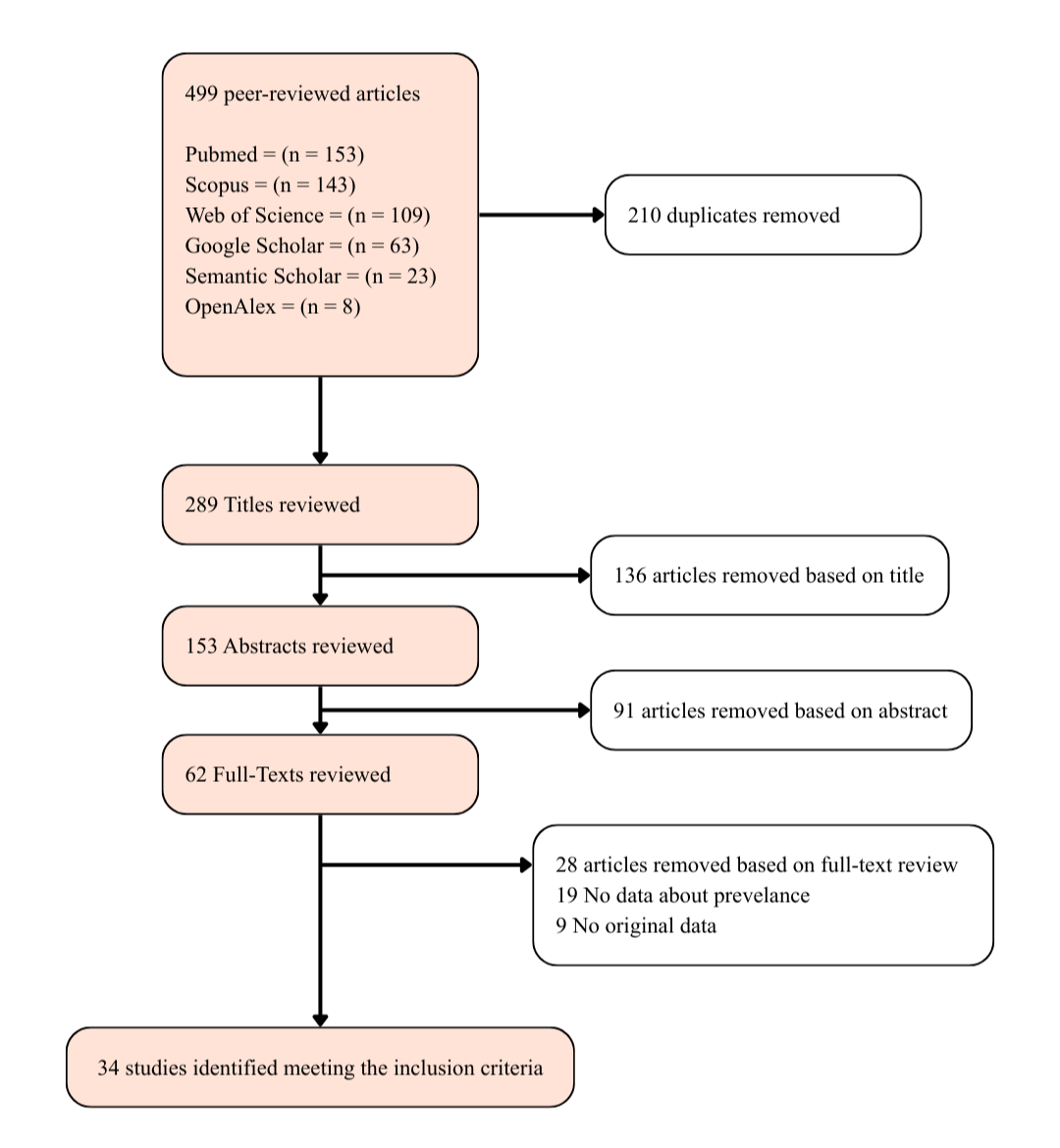
Flowchart illustrating the systematic process of identifying, screening, and determining the eligibility of studies for inclusion in the final review, resulting in 34 included sources for the final analysis, following the PRISMA 2020 guidelines
LAB were the predominant decontamination agents, appearing in 33 of 34 studies, followed by yeasts (n=9), Bifidobacterium (n=5), Enterococcus (n=4), Lactococcus (n=3), and synbiotic or multi-strain cocktail formulations (n=3). Most studies employed liquid milk as the test matrix, but a subset utilized complex dairy matrices including Frescal cheese
, sarshir , and doogh , enabling limited assessment of the influence of lipid and protein complexity on decontamination performance.3.3. Efficacy and Mechanistic Classification
Reported removal efficiencies ranged from 13% to >99%, representing substantial heterogeneity attributable to differences in microbial species and strain, biomass concentration, dairy matrix composition, initial AFM1 concentration, temperature, and pH. Twelve studies reported peak removal exceeding 90%. However, 30 of 34 studies (88.2%) attributed AFM1 removal to physicochemical adsorption to microbial cell-wall components rather than enzymatic degradation of the toxin molecule (see Table 1). Only four studies provided evidence consistent with degradation , , , , and of these, only Martínez et al. claimed identification of less-toxic degradation metabolites, though without full structural characterization by tandem mass spectrometry.
AFM1 Removal Efficacy, Proposed Mechanisms, and Key Methodological Limitations Across 34 Included Studies
GI: gastrointestinal; CFU: colony-forming units; NPs: nanoparticles; MS/MS: tandem mass spectrometry
Study | Microorganism(s) | Dairy Matrix | Peak Removal (%) | Proposed Mechanism | Key Methodological Limitation |
Barukčić et al. | LAB starter cultures | Fermented milk | 13–31 | Adsorption | Low efficacy; toxin dissociation observed during refrigerated storage |
Rezasoltani et al. | S. boulardii, L. casei | Reconstituted milk | 75–88 | Binding | Efficacy inversely correlated with initial AFM1 concentration |
Kuharić et al. | Native LAB | Raw milk | >50 | Binding/physical | Required centrifugation and filtration; industrially cost-prohibitive |
Sanaldi & Coban | Probiotics | Various milk types | 40–70 | Adsorption | High variability with milk fat content; mechanism undetermined |
Salem-Bekhit et al. | L. rhamnosus, S. cerevisiae | Milk | >90 | Adsorption | Efficacy contingent on Box–Behnken process optimization |
Jebelli Javan et al. | Cottage cheese LAB isolates | Milk | 35–65 | Binding | Strain-specific; binding destabilized under high-acidity conditions |
Sarlak et al. | Probiotics | Doogh | 50–65 | Adsorption | Significant alterations to sensory and fermentation profiles |
Martínez et al. | Mixed bacteria and yeasts | Milk | 80–100 | Degradation (claimed) | One of four degradation-claiming studies; metabolites not structurally identified by MS/MS |
Anvar et al. | S. boulardii + LAB | Milk | 60–80 | Biophysical | Multi-step biophysical process; scalability undemonstrated |
Abdelmotilib et al. | Probiotic cocktails | Milk | >90 | Adsorption | Non-specific binding of milk macronutrients documented |
Gonçalves et al. | Non-viable LAB | Frescal cheese | 40–60 | Adsorption | Efficacy dependent on high biomass concentrations (>10⁹ CFU/mL) |
Panwar et al. | Indian Lactobacilli | Simulated GI model | 30–55 | Binding | Significant toxin desorption during simulated gastric phase |
Ismail et al. | High-concentration microbes | Milk | 45–95 | Binding | Requires excessive microbial loads (>10⁹ CFU/mL) for peak efficacy |
Adácsi et al. | Cell fractions | Milk | 30–50 | Surface binding | Fractionated cells showed lower efficacy versus intact cells |
Güner et al. | Inactivated LAB | Milk | 60–85 | Adsorption | Heat-inactivation compromised binding site structural integrity |
Riad et al. | Synbiotic + ZnO nanoparticles | Milk | >95 | Complexation | Potential cytotoxicity of ZnO nanoparticle residues not assessed |
Hamad et al. | Nanoencapsulation cocktail | Milk | 85–98 | Adsorption | High technical complexity; residual toxin risk unquantified |
Hashemi & Amiri | L. reuteri | Sarshir | 70–90 | Adsorption | Confirmed high desorption rates under acidic and ionic conditions |
Nahle et al. | LAB biofilms | Milk | 60–80 | Bio-sequestration | Industrial biofilm maintenance not feasible at scale |
Kamyar & Movassaghghazani | Kefir starter culture | Milk | 40–55 | Adsorption | Fermentation time constraints limit practical applicability |
Adriansyah et al. | Kefir microbiota | Milk | 30–60 | Binding | High inter-grain variability; standardization unaddressed |
Jiménez-Pérez et al. | Kefir-derived polysaccharides | Milk | 40–55 | Adsorption | Low binding capacity compared to living biomass |
Møller et al. | Multiple LAB strains | In vitro (milk) | 20–80 | Multi-toxin binding | Non-specific; co-sequestration of fat-soluble vitamins documented |
Rabie et al. | Probiotics | Dairy products | 45–70 | Binding | Post-storage toxin recovery confirmed in multiple product formats |
Fakhrabadipour et al. | B. bifidum | Skim milk | 55–80 | Adsorption | Efficacy markedly reduced in full-fat matrix |
Almutairi et al. | L. lactis + inulin | Milk | 65–85 | Adsorption | Prebiotic–toxin interactions complicate safety interpretation |
Assaf et al. | L. rhamnosus biofilm | Milk | 80–100 | Adsorption | High removal rate, but biofilm sloughing risk identified |
Gonçalves et al. | Mixed methods | Cheese | 40–60 | Binding | Incomplete removal in complex solid matrix |
Faghihi et al. | Probiotics vs. natamycin | Milk | 50–75 | Adsorption | Microbial binding less stable than chemical natamycin benchmark |
Fagbemi | L. brevis | Raw milk | 35–55 | Binding | Low efficacy against raw milk contaminants; mechanism uncharacterized |
Shahrestani et al. | Probiotics | Milk | 50–70 | Adsorption | pH fluctuations triggered measurable toxin release |
Yüksel & Albayrak | L. plantarum NRRL B4496 | Milk | 40–65 | Adsorption | Reversibility confirmed by wash-step desorption experiments |
Sevim et al. | Novel biological agents | Milk | 70–95 | Adsorption | AFM1 bioaccessibility remained elevated following treatment |
Chaudhary & Patel | W. confusa, L. plantarum | Milk/aqueous | 60–90 | Adsorption | High efficacy but mechanism confirmed as purely surface-based |
4.4. Analytical Quality and Risk of Bias
The RoB assessment revealed that over 65% of included studies did not report LOD, LOQ, or percent analyte recovery (Table 2). Furthermore, fewer than 25% of studies rigorously tested for toxin reversibility through desorption-challenge experiments, meaning that the permanence of AFM1 removal was empirically unverified in the large majority of studies
. The analytical deficit was not uniformly distributed: Standard LAB studies (n=18) exhibited the highest overall RoB, while studies published in 2024–2026 demonstrated markedly improved analytical rigor , .
Risk of Bias (RoB) Assessment of Analytical Quality Across Study Categories
LOD: limit of detection; LOQ: limit of quantification; RoB: risk of bias. Values represent the percentage of studies within each category reporting the indicated parameter
Study Category | n | LOD/LOQ Reported (%) | Recovery Rate Reported (%) | Matrix Effects Assessed (%) | Desorption Tested (%) | Overall RoB |
Standard LAB studies | 18 | 35 | 40 | 15 | 20 | High |
Yeast/mixed culture studies | 8 | 45 | 50 | 25 | 15 | Medium–High |
Nano/synbiotic studies | 4 | 75 | 80 | 60 | 10 | Medium |
Recent studies (2024–2026) | 4 | 90 | 90 | 85 | 75 | Low |
4. Discussion
4.1. Sequestration versus Elimination
The overwhelming prevalence of adsorption-based removal (88% of studies) highlights a widespread scientific preference for rapid, surface-level results over structural detoxification. Surface binding is an equilibrium-driven process rather than a terminal one. Studies such as Hashemi and Amiri
and Panwar et al. document that the microbe–toxin complex is highly susceptible to the physicochemical fluxes of the human digestive tract. If the AFM1 molecule remains chemically intact, it acts as a latent carcinogen, potentially desorbing in the small intestine where the dihydrofuran ring, the primary site of genotoxicity, remains available for biological activation . True safety can only be guaranteed by methods that prioritize the irreversible cleavage of the AFM1 molecular scaffold .It is important to acknowledge that high removal efficiencies reported in adsorption-based studies, particularly those exceeding 90%, remain technically significant, especially in contexts where initial concentrations far exceed regulatory thresholds. However, the permanence of this reduction under physiologically relevant conditions has not been established for the majority of these systems. The regulatory frameworks of EFSA and FDA would require precise mechanistic characterization and stability data before any biological decontamination agent could be approved for commercial dairy application
.4.2. Analytical Gap and Regulatory Translation
Over 65% of existing literature fails to report fundamental validation parameters (LOD, LOQ, and recovery rates), suggesting a systemic lack of rigor in the field's current analytical culture
. For a Group 1 carcinogen with a regulatory threshold as low as 0.05 μg/L, any reported reduction must be statistically robust and reproducible. Without accounting for matrix effects, the interference of milk lipids and proteins that cause signal suppression in ELISA-based detection and ion suppression in HPLC-MS/MS, efficacy rates remain purely academic . The RoB assessment (Table 2) clearly stratifies the literature by analytical quality, demonstrating that the Standard LAB category, which forms the foundation of current research, carries the highest analytical risk of bias.A positive trend is evident in studies published in 2024–2026, with 90% reporting LOD/LOQ, 90% reporting recovery rates, and 75% conducting desorption-challenge experiments. This suggests the field is maturing toward standards necessary for industrial application. Future work must align with AOAC or ISO validation frameworks to enable meaningful cross-study comparison and regulatory submission.
4.3. Matrix Complexity and Scalability Challenges
A recurring limitation is the predominant use of simplified liquid milk models. The limited studies conducted in fat-rich matrices (e.g., sarshir, full-fat milk) or solid matrices (e.g., Frescal cheese) consistently report reduced decontamination efficacy compared to skim or reconstituted milk models
, . This reflects the well-documented affinity of aflatoxins for milk lipid and casein fractions , which compete with microbial binding sites. The industrial scalability of microorganism-based decontamination is further constrained by the requirement for high biomass concentrations (>10⁹ CFU/mL) documented in multiple studies , and the technical challenges of biofilm maintenance and nanoparticle safety assessment in systems such as those employing ZnO nanoparticles .4.4. Toward Small-Molecule Biotransformation
The collective limitations of microbial binding point toward a necessary evolution into small-molecule biotransformation. A promising avenue involves the use of natural polyphenolic compounds that possess innate degradative capabilities
. Curcumin has been shown via DFT calculations and molecular docking to form stable non-covalent complexes with AFM1 through π–π stacking and hydrogen bonding interactions , and photosensitization-based approaches have demonstrated antifungal efficacy against Aspergillus flavus . A synergistic combination of curcumin with fermentation-derived microbiota has been previously explored , though robust toxicological characterization of resulting transformation products remains an essential prerequisite before any regulatory or industrial application can be considered .5. Conclusion
This systematic review of 34 original research studies demonstrates that while microorganism-based biological interventions can achieve substantial AFM1 removal from dairy matrices, with peak efficiencies exceeding 90% in 12 studies, the dominant mechanism (reversible cell-wall adsorption in 88% of studies) renders current strategies fundamentally insufficient for guaranteed consumer protection. The equilibrium-driven nature of adsorption creates an inherent risk of toxin desorption under the physiological conditions of the gastrointestinal tract, a risk that is empirically quantified in only a minority of the reviewed studies. Compounding this mechanistic limitation is a pervasive analytical gap, with over 65% of studies failing to report LOD, LOQ, or recovery rates.
Two interconnected research imperatives follow from these findings. First, a mechanistic pivot is required, from passive adsorption toward enzymatic biodegradation strategies, with full structural identification of degradation metabolites by high-resolution MS techniques (e.g., Q-TOF or Orbitrap-based MS/MS) . Second, analytical standardization is essential: all future decontamination studies must report AOAC- or ISO-compliant validation parameters, including matrix-matched calibration, recovery rates, and desorption-challenge experiments , . Only through this dual commitment, to irreversible molecular transformation and to rigorous analytical verification, can biological AFM1 decontamination achieve the scientific and regulatory credibility required for adoption within integrated dairy safety management systems.
6. AI Declaration
During manuscript preparation, Elicit AI was used for automated literature identification across multiple databases and preliminary extraction of study metadata. All extracted data were subsequently verified against original full-text articles by the author, who takes sole and complete responsibility for the scientific content herein.